


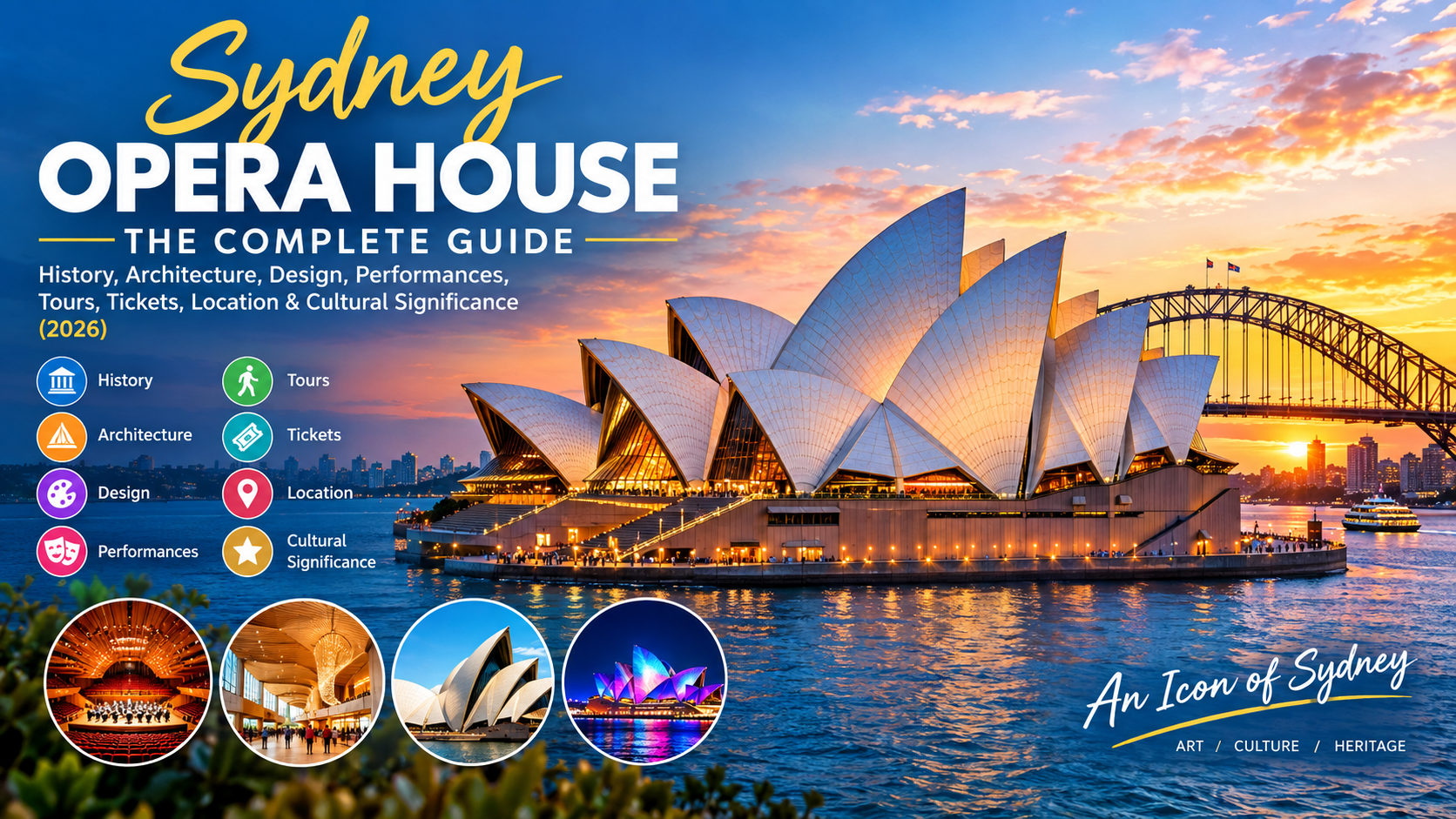
The Sydney Opera House is far more than a famous white landmark beside Sydney Harbour. It is an architectural experiment, a major performing arts centre, a protected heritage site, and one of the clearest examples of how ambitious design can reshape a city’s identity. Designed by Danish architect Jørn Utzon, the building combines expressive form, structural engineering, craft, landscape and performance in a way that remains remarkable decades after its opening.
For visitors, it can look effortless: a series of bright sails floating above the harbour. Behind that visual simplicity lies a complicated story of competition, engineering breakthroughs, political controversy, construction challenges and long-term conservation. UNESCO inscribed the building on the World Heritage List in 2007, recognizing its outstanding universal value as a masterpiece of 20th-century architecture.
This guide explores what makes the landmark important, how its architecture works, what happened during construction, and why it continues to matter in contemporary Australian culture.
What is the Sydney Opera House and why is it famous?
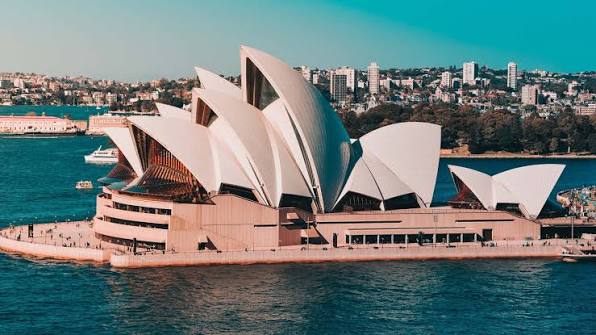
The landmark is a performing arts centre on Bennelong Point in Sydney Harbour. It opened in 1973 and contains multiple performance venues, public spaces, restaurants and foyers. Its most recognizable feature is the group of interlocking vaulted shells that rise from a broad podium and appear to echo sails, clouds, shells or waves depending on the viewer’s position. UNESCO highlights the relationship between its architectural form, structural design and harbour setting.
Its fame comes partly from that instantly recognizable silhouette, but the deeper reason is the building’s integration of architecture and engineering. Rather than treating the roof as decoration placed on top of a conventional building, Utzon made the roof geometry central to the architectural idea. The result became an urban sculpture that also functions as a working arts venue. As the Opera House explains, Utzon wanted the building to elevate and celebrate the performing arts rather than simply contain them.
The story behind Jørn Utzon’s extraordinary design
The story of the Sydney Opera House begins with an international competition announced in 1956 for a new opera house at Bennelong Point. Jørn Utzon, then a relatively young Danish architect, submitted design number 218 and won in 1957 from more than 220 entries. His proposal stood out because it responded directly to the harbour landscape instead of treating the site as an ordinary urban block.
Utzon’s thinking was influenced by modernism, Scandinavian design, ancient architecture and natural forms. He studied Sydney Harbour carefully and imagined the performance spaces as powerful sculptural volumes rising from the peninsula. His approach also reflected a belief that architecture could have a poetic dimension. In his work, function did not have to eliminate emotion; structure, material and place could work together to create a memorable human experience.
The engineering breakthrough that made the shells possible
One of the hardest problems was turning Utzon’s expressive roof sketches into something that could actually be constructed. Between 1958 and 1962, the roof geometry evolved through several approaches before the design team arrived at a spherical solution. By deriving the shells from the surface of a sphere, engineers could create a more unified system of repeated components instead of treating every curved section as completely unique.
This breakthrough connected visual design with mathematical logic. Ove Arup and his engineering team played a crucial role in developing solutions capable of supporting the enormous roof structures. It is a useful architectural lesson: when a beautiful idea seems impossible to build, changing the underlying geometry can sometimes solve both the technical and aesthetic problem at once.
Why the famous roof looks white from a distance
The roof is covered with more than one million specially made ceramic tiles arranged in chevron patterns. They were designed with a subtle texture rather than a highly reflective mirror finish, allowing the shells to respond to changing daylight without excessive glare. Official records state that the roof contains 1,056,006 tiles.
That surface explains why photographs can make the building look dramatically different from one moment to another. Under bright midday light, the shells can appear brilliant white; under cloudy skies, they become softer and grey; around sunset, they can take on warmer tones. The architecture therefore behaves almost like an environmental canvas, constantly changing with the harbour, sky and time of day.
Construction was a long and controversial process
Construction of the Sydney Opera House began on 2 March 1959. The project quickly became more difficult than the original plans suggested, partly because the final roof geometry was still being resolved while construction was underway. The building was formally opened on 20 October 1973, following years of technical, financial and political challenges.
The project also became entangled in professional and political conflict. Utzon left the project during construction, and Australian architect Peter Hall later led design work that completed the interiors and remaining stages. This history matters because the finished building was not produced by one person working in isolation. It was the result of architects, engineers, builders, craftspeople, government decisions and later design teams solving different problems over many years.
The performance spaces make the building more than a monument
A common mistake is to think of the Opera House primarily as a photographic landmark. In reality, it is a working performing arts centre. Its spaces have hosted opera, theatre, ballet, orchestral music, contemporary performance, festivals, talks and other cultural events, allowing the building to function as a living institution rather than a frozen monument.
That distinction is important for heritage conservation. A historic building that stops serving its purpose can become disconnected from everyday life. The Opera House has instead continued to evolve while protecting its architectural character. Its management approach seeks to balance conservation with the practical needs of a modern arts organization, helping the site remain culturally active as well as architecturally significant.
UNESCO World Heritage status and what it means
UNESCO added the building to the World Heritage List in 2007 under criterion (i), recognizing it as a masterpiece of 20th-century architecture. The designation highlights its exceptional design, engineering achievements, technological innovation and influence on later architecture. UNESCO also emphasizes the relationship between the building and its remarkable harbour setting.
World Heritage status does not simply mean that a building is famous. It identifies places considered to have outstanding universal value and establishes a framework for protecting the qualities that make them significant. For the Opera House, conservation therefore involves much more than keeping the shells looking clean. Materials, spaces, colour, function, setting and architectural principles all form part of the heritage picture.
The Gadigal connection and the meaning of Tubowgule
The site has a much older cultural history than the modern building. Bennelong Point is known to the traditional custodians, the Gadigal, as Tubowgule. The Opera House acknowledges the area’s significance as a place connected with ceremony, gathering and celebration in Aboriginal Australia.
Understanding this history adds an essential layer to the way the landmark should be experienced. The modern building did not create the cultural importance of the location; it occupies a place with its own Indigenous history and relationship to Country. Contemporary heritage interpretation therefore considers both the architectural achievement and the living cultural traditions connected with the site.
Why the Sydney Opera House remains an architectural icon
The building remains influential because it solved several difficult problems at the same time. It created a powerful visual identity, responded to a dramatic natural setting, introduced innovative structural thinking and established a major cultural venue. Many buildings are technically impressive but visually anonymous; others are visually striking but difficult to use. The Opera House became important because architecture, engineering, landscape and cultural purpose were tightly connected.
Its continuing influence can also be understood through the way people remember it. A visitor may forget exact dimensions but remember the sensation of seeing the sails appear across the harbour. That emotional recognition is part of architectural success. The structure became an image of Sydney and modern Australia while retaining a sense of mystery that encourages closer inspection.
Key facts at a glance
| Feature | Detail |
|---|---|
| Location | Bennelong Point, Sydney Harbour, Australia |
| Traditional place name | Tubowgule |
| Architect | Jørn Utzon |
| Construction began | 1959 |
| Official opening | 20 October 1973 |
| UNESCO World Heritage inscription | 2007 |
| Architectural character | Late modernist / expressionist |
| Roof system | Interlocking spherical shells |
| Roof tiles | 1,056,006 |
| Main role | Performing arts, culture, tourism and public gathering |
These facts show why the Opera House cannot be reduced to a single category. It is simultaneously an architectural landmark, engineering achievement, cultural institution, tourism destination and heritage property. Its value comes from the interaction of those roles rather than from its appearance alone.
What visitors can learn from the building
For a first-time visitor, the most rewarding approach is to look beyond the famous exterior. Notice how the shells meet the podium, how the roof tiles change with the light, how the harbour frames the building and how circulation spaces turn movement into part of the experience. An architectural tour can reveal details that are easy to miss from outside, including the relationship between Utzon’s concepts and engineering solutions developed with Ove Arup.
The building is also a real-world example of design iteration. Its history demonstrates that landmark architecture rarely emerges from a single perfect drawing. Ideas evolve, technical problems force revisions, materials influence form and later teams may complete work under very different circumstances. That makes the Opera House valuable not only to tourists but also to students and professionals interested in architecture, engineering, project management and heritage conservation.
Read More: Honeymoon Destinations: 10 Powerful Insights for Choosing the Perfect Romantic Escape
Frequently asked questions
Why is the Sydney Opera House so famous?
The Sydney Opera House is famous because its distinctive shell-shaped architecture, harbour setting and cultural role combine into an instantly recognizable landmark. Its significance was reinforced by UNESCO World Heritage recognition in 2007, which identifies the building as a masterpiece of 20th-century architecture.
Who designed the Sydney Opera House?
The original design was created by Danish architect Jørn Utzon, who won the international competition in 1957. The completed building also reflects the work of engineers, builders and later architect Peter Hall, making its final form a collaborative achievement rather than the product of one individual alone.
When did the Sydney Opera House open?
The landmark officially opened on 20 October 1973. The opening followed a long construction period that began in 1959 and included major changes to the roof design, technical challenges and significant political and professional controversy.
Why does the Sydney Opera House have shells?
The shell-like roofs were central to Utzon’s sculptural concept and were eventually developed using spherical geometry. This approach allowed the complex curved forms to be produced through a more systematic structural method, helping transform an ambitious architectural idea into a buildable design.
Is the Sydney Opera House a UNESCO World Heritage Site?
Yes. UNESCO inscribed the building on the World Heritage List in 2007 under criterion (i). The designation recognizes its architectural, engineering and technological achievements and the way its design responds to Sydney Harbour.
What is the Sydney Opera House used for today?
The landmark continues to operate as a major performing arts centre, presenting a broad range of cultural events while also serving as a public and tourism destination. Its continued use is important to its heritage because conservation is balanced with the needs of a living cultural institution.
Conclusion
The Sydney Opera House endures because it is much more than an impressive silhouette. Its story brings together Jørn Utzon’s bold architectural vision, Ove Arup’s engineering expertise, difficult construction decisions, Indigenous cultural history, performing arts and decades of careful conservation. UNESCO recognition confirms the building’s global architectural importance, while its continued use gives that heritage a living purpose.
The strongest takeaway is simple: great architecture is not only about how a building looks. It is about how design, engineering, place, culture and human experience reinforce one another. That is why the Sydney Opera House remains one of the world’s most recognizable cultural landmarks and one of the clearest demonstrations that ambitious architecture can become part of a city’s identity.