


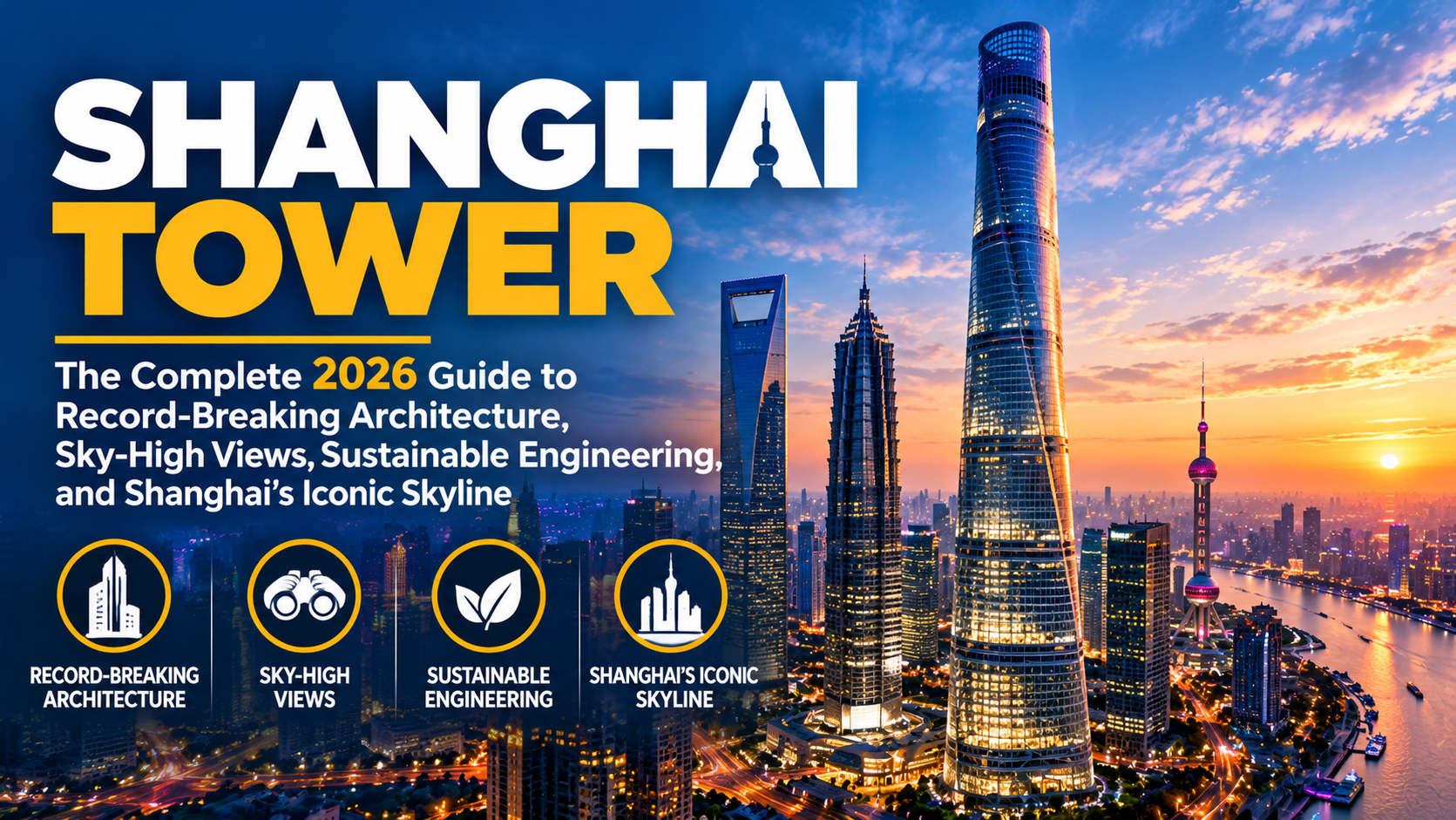
Shanghai Tower is one of the world’s most remarkable skyscrapers, rising 632 meters above Shanghai’s Lujiazui financial district. Its twisting glass exterior, innovative engineering, and extraordinary height make it a defining feature of China’s modern skyline. More than a spectacular building, it represents the ambition of contemporary urban design and the technical challenges involved in constructing supertall towers.
Completed in 2015, the skyscraper stands among the world’s tallest buildings and is the tallest building in China by architectural height. Its location beside the Huangpu River places it within a striking cluster of landmark structures, including the Jin Mao Tower and Shanghai World Financial Center.
For architecture enthusiasts, travelers, engineers, and anyone interested in modern cities, the tower offers a fascinating look at how design, technology, and sustainability come together. This guide explores its height, architectural features, construction, observation experience, environmental systems, and practical visitor information.
Where Is Shanghai Tower Located?
The skyscraper stands in Lujiazui, a major financial and commercial district in Pudong, Shanghai, China. The area developed into one of the country’s most recognizable business centers, with glass office towers, luxury hotels, shopping complexes, and public spaces concentrated along the eastern side of the Huangpu River.
Its surroundings make the building especially impressive. The Jin Mao Tower combines modern engineering with design elements inspired by traditional Chinese pagodas, while the Shanghai World Financial Center is recognizable for its tall rectangular form and opening near the top. Together, these structures create a distinctive skyline that illustrates Shanghai’s transformation into a global financial hub.
Visitors can reach the district using Shanghai Metro, including services to Lujiazui station, followed by a walk toward the tower. The precise route depends on the station exit and current access arrangements, so checking a navigation app before departure is useful.
Height, Floors, and World Records
At 632 meters (approximately 2,073 feet), Shanghai Tower has 127 above-ground floors and five basement levels, according to commonly published building specifications. Floor counts can vary slightly between sources depending on how mechanical and service levels are classified, but the building’s architectural height is widely established.
Its height places it among the world’s tallest completed buildings. It is taller than the nearby Shanghai World Financial Center, which reaches 492 meters, and the Jin Mao Tower, which reaches approximately 420.5 meters. These three skyscrapers form a recognizable trio in Lujiazui.
| Feature | Details |
|---|---|
| Location | Lujiazui, Pudong, Shanghai, China |
| Architectural height | 632 meters (2,073 feet) |
| Above-ground floors | 127 |
| Basement levels | 5 |
| Completion | 2015 |
| Primary use | Offices, hospitality, retail, and observation facilities |
| Architect | Gensler, working with a multidisciplinary design team |
| Structural engineering | Thornton Tomasetti and other specialist teams |
Height records should be understood using consistent measurements. Architectural height generally includes permanent architectural features but excludes antennas and other structures that do not qualify under the relevant measurement rules. This distinction matters when comparing skyscrapers around the world.
The Twisting Architecture Behind the Tower


One of the building’s defining features is its gently twisting shape. Designed by the international architecture firm Gensler, the tower rotates approximately 120 degrees from its base toward its upper levels. Its silhouette creates the impression of a glass structure turning as it rises, giving it a distinctive appearance among conventional rectangular skyscrapers.
The curved exterior is more than an aesthetic choice. The twisting form helps reduce wind loads compared with a conventional square tower, while the tapered profile contributes to structural efficiency. The design was developed through extensive engineering analysis to balance appearance, occupant comfort, construction requirements, and performance in Shanghai’s challenging weather conditions.
The building also incorporates a double-skin facade, meaning two layers of glass create an intermediate space around substantial portions of the tower. This arrangement helps provide insulation and creates buffer zones between the exterior environment and interior spaces. The result is an architectural system designed to combine visual transparency with practical environmental performance.
Engineering and Construction Challenges
Building a skyscraper of this height requires careful coordination between structural engineering, materials science, wind analysis, and construction logistics. Shanghai Tower uses a reinforced concrete core, a substantial structural frame, and large-scale outrigger systems to help resist lateral forces. These components work together to support the building’s weight and manage movement caused by wind and other loads.
Wind is particularly important in supertall buildings. As height increases, wind pressure and occupant sensitivity to movement become major design considerations. Engineers use sophisticated modeling, including wind-tunnel testing, to evaluate how air moves around a structure and to refine its shape. The tower’s twisting geometry is part of this broader strategy, rather than a decorative feature added after the engineering was complete.
Construction also presented challenges associated with transporting materials, coordinating contractors, and working at extreme heights. High-performance concrete, steel components, lifting equipment, and carefully planned construction sequences were necessary to assemble the structure safely. Its completion in 2015 demonstrated the capabilities of large multidisciplinary teams working on complex urban infrastructure.
Sustainability and Energy-Efficient Design
Sustainability was a central consideration in the tower’s design. The double-skin facade helps reduce unwanted heat transfer, while the building’s orientation, glazing, and environmental controls contribute to managing energy demand. Rather than relying on a single technology, the project integrates several systems intended to improve performance across its large interior spaces.
The design also incorporates features associated with water conservation, efficient lighting, and improved building management. Wind turbines installed near the upper levels generate some electricity, although they supply only a small portion of the building’s overall energy needs. Such systems illustrate how renewable energy can contribute to a larger strategy without independently powering a skyscraper of this scale.
The tower has received recognition for its sustainability efforts, including LEED Platinum certification. However, environmental performance depends on how a building operates after construction as well as how it was designed. Occupancy, equipment use, maintenance, climate, and energy sources all influence its real-world footprint.
Observation Deck and Visitor Experience


For many travelers, the main attraction is the opportunity to see Shanghai from an extraordinary height. The observation facilities provide views across Lujiazui, the Huangpu River, and the city’s dense urban landscape. On clear days, visitors can appreciate the scale of Shanghai’s development and see how the historic waterfront contrasts with Pudong’s modern skyscrapers.
The experience is particularly rewarding around sunset, when daylight gradually gives way to illuminated buildings and bridges. However, visibility depends on weather, haze, and atmospheric conditions. A cloudy day may limit distant views, so checking the forecast and visibility before visiting can improve the experience.
Access arrangements, observation-deck opening hours, ticket prices, and available visitor areas can change. Before making the trip, consult the building’s official visitor information or a trusted ticket provider. Do not assume that every floor is accessible to the public, because many parts of the tower are private office, hotel, or service areas.
What Makes Shanghai Tower Different From Other Skyscrapers?
The building stands out because of the way its height, form, engineering, and mixed-use planning work together. Some skyscrapers are primarily office towers, while others are famous for a particular observation deck or unusual silhouette. This tower combines a twisting exterior, double-skin facade, extensive vertical circulation, and a range of commercial and hospitality functions.
Its location also gives it a special role in Shanghai’s skyline. Visitors can compare its curved profile with the angular Shanghai World Financial Center and the tiered appearance of the Jin Mao Tower. Seeing the three structures together helps explain how skyscraper design has evolved from recognizable geometric forms toward more complex shapes informed by engineering and environmental considerations.
| Building | Height | Distinctive feature |
|---|---|---|
| Shanghai Tower | 632 m | Twisting form and double-skin facade |
| Shanghai World Financial Center | 492 m | Trapezoidal opening near the top |
| Jin Mao Tower | 420.5 m | Tiered design inspired by traditional pagodas |
These buildings are more than competing height records. Together, they demonstrate different approaches to structural design, architectural identity, and the use of dense urban land in a major financial district.
Best Time to Visit and Practical Travel Tips
Spring and autumn are often comfortable seasons for exploring Shanghai, with conditions generally more suitable for walking between attractions. Summer can be hot and humid, while winter is colder and may bring less comfortable outdoor conditions. Weather varies, so check the forecast before planning a skyline visit.
Allow time to explore the wider Lujiazui area instead of visiting the observation deck alone. The surrounding waterfront and nearby public spaces provide opportunities to photograph the skyscrapers from street level. You can also visit the Bund on the opposite side of the Huangpu River for a classic view of Pudong’s skyline.
For a smoother visit, reserve tickets in advance if required, arrive with enough time for security procedures, and keep your schedule flexible if visibility is poor. Travelers with limited time can combine the tower with other nearby attractions, while architecture enthusiasts may prefer to spend longer examining the buildings’ different forms and facades.
Frequently Asked Questions
How tall is Shanghai Tower?
Shanghai Tower is 632 meters tall, equivalent to approximately 2,073 feet. It has 127 above-ground floors and five basement levels. Its architectural height makes it the tallest building in China and one of the tallest completed buildings in the world.
When was Shanghai Tower completed?
Construction was completed in 2015. The project involved extensive structural engineering, advanced facade design, and coordination across multiple construction disciplines. It became a major landmark in Shanghai’s Lujiazui financial district.
Can tourists visit the observation deck?
Visitors may be able to access designated observation facilities, subject to current opening hours, ticket arrangements, and operating conditions. Because public access can change, check official visitor information before traveling rather than assuming every upper floor is open.
Who designed Shanghai Tower?
The tower was designed by Gensler, an international architecture firm, working with a multidisciplinary team of architects, engineers, and technical specialists. Its twisting shape reflects a combination of architectural goals and engineering analysis.
Is Shanghai Tower the tallest building in the world?
No. It is among the world’s tallest completed buildings, but it is shorter than Burj Khalifa in Dubai, which stands 828 meters tall. Rankings can change as new buildings are completed, so comparisons should use consistent height definitions.
What makes Shanghai Tower environmentally efficient?
Its sustainability features include a double-skin glass facade, energy-management systems, water-conservation measures, and wind turbines near the upper levels. These features can improve efficiency, although the building’s actual environmental impact also depends on how it is operated and maintained.
How long should you spend visiting the tower?
Allow approximately two to three hours if you plan to visit the observation facilities, take photographs, and explore the surrounding district. Extra time may be useful during busy periods or if you want to visit nearby landmarks and photograph the skyline from multiple viewpoints.
Conclusion
Shanghai Tower is a remarkable example of modern skyscraper design, combining extraordinary height with a twisting architectural form, advanced structural engineering, and sustainability-focused systems. Its position in Lujiazui places it at the heart of one of the world’s most recognizable financial-district skylines.
Whether you are interested in architecture, engineering, urban development, or panoramic city views, the tower offers a compelling way to understand Shanghai’s transformation into a global metropolis. Its significance extends beyond its height: the building demonstrates how ambitious design must work alongside structural performance, environmental considerations, and practical urban needs.
The key takeaway is that a great skyscraper is more than a tall structure. It is a carefully coordinated system of architecture, engineering, and urban life—and this landmark illustrates how those elements can come together to shape a city’s identity.