


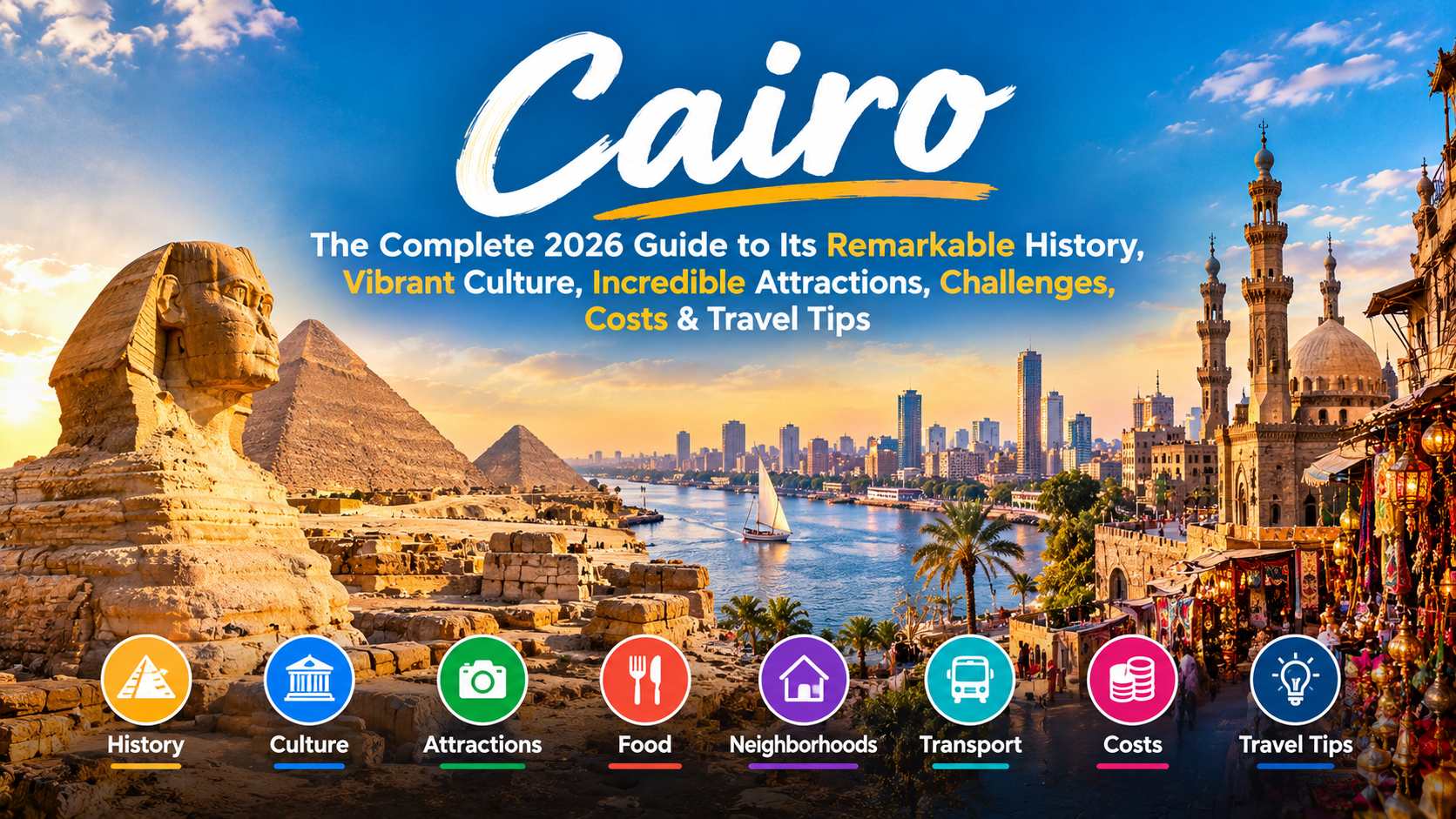
Cairo is Egypt’s sprawling capital and one of the world’s great historic cities, where ancient monuments, medieval streets, modern districts, busy markets, and the Nile exist side by side. It is the natural gateway for travelers interested in ancient Egyptian civilization, but its appeal extends well beyond the pyramids.
Cairo can feel intense at first: traffic is lively, streets are crowded, and the scale of urban life is enormous. Yet that energy is part of its character. A thoughtful itinerary reveals a place shaped by thousands of years of history, with the Giza Plateau, Egyptian Museum, the historic Islamic district, Coptic heritage, Khan el-Khalili, and the Nile each offering a different perspective.
Why Cairo Is a Remarkable Destination
The capital sits near the Nile in northern Egypt and functions as the country’s cultural, political, economic, and transportation center. Its historic importance is closely connected with nearby Giza and the broader Nile Valley, making the metropolitan area a concentrated introduction to ancient and modern Egypt.
What makes the city especially interesting is the contrast between eras. Within the same day, a traveler can stand before the Great Pyramid of Giza, walk through a medieval Islamic quarter, examine Coptic Christian heritage, and finish with dinner overlooking the river. It is less like visiting a single monument and more like reading several chapters of Egyptian history in one place.
The Pyramids of Giza and Ancient Egyptian Heritage
The Giza Plateau is the defining attraction for many visitors. The Great Pyramid of Giza, the Pyramid of Khafre, the Pyramid of Menkaure, and the Great Sphinx form an extraordinary archaeological landscape that demonstrates the engineering, organization, religious beliefs, and political power of ancient Egypt.
A useful way to understand the pyramids is to look beyond their enormous stones. They were part of a larger funerary landscape involving temples, causeways, workers, rituals, and royal symbolism. Visiting with a knowledgeable guide or using a reliable historical resource can transform the experience from a photo stop into a deeper lesson about the Old Kingdom.
Museums and Ancient Egyptian Collections
The Grand Egyptian Museum has become a major focus for travelers seeking a modern setting for Egypt’s archaeological heritage, while the historic Egyptian Museum remains important for its extensive collections and long-established role in Egyptology. Museum visits help provide context that is difficult to absorb from monuments alone.
For example, seeing royal objects, funerary artifacts, statues, inscriptions, and everyday items can make ancient Egyptian society feel much more human. Instead of viewing the civilization only through monumental architecture, visitors can consider how people lived, worshipped, governed, worked, and prepared for death. That context makes the Giza experience considerably richer.
Islamic Cairo, Coptic Heritage and Historic Neighborhoods
The Islamic district is one of the city’s most atmospheric areas, with historic mosques, madrasas, gates, markets, and narrow streets reflecting centuries of urban development. Al-Muizz Street is particularly notable for its concentration of medieval Islamic architecture, while the Citadel offers broad views across the capital and a powerful connection to Egypt’s later political history.
Coptic heritage presents another important layer of the city’s history. Churches, religious sites, and museums reflect the long history of Egypt’s Coptic Christian community. Exploring these districts slowly is often more rewarding than rushing between landmarks because architectural details, street life, and small shops reveal how history remains woven into everyday surroundings.
Food, Markets and Everyday Life
Cairo’s food culture is an essential part of the travel experience. Local staples include koshari, ful medames, ta’ameya, molokhia, grilled meats, mahshi, and a wide range of breads, pastries, and desserts. Koshari, made with ingredients such as rice, pasta, lentils, chickpeas, tomato sauce, and fried onions, is particularly useful for understanding the country’s casual comfort-food culture.
Khan el-Khalili is famous for shopping, but its value is not limited to souvenirs. The surrounding streets provide opportunities to observe traditional crafts, cafés, spices, jewelry, textiles, and the social rhythm of an old commercial district. A practical approach is to browse without rushing, compare prices, and distinguish genuine craftsmanship from mass-produced tourist merchandise.

Getting Around and Navigating the City
Cairo’s traffic is one of the biggest practical challenges for visitors. Distances that look short on a map can take much longer during busy periods, so building extra time into a sightseeing schedule is important. The city’s Metro can be useful for selected journeys, while taxis and ride-hailing services can provide more direct transportation.
The best solution to the city’s transportation problem is not trying to cross the entire metropolitan area repeatedly. Group nearby attractions together. A day focused on Giza should concentrate on the plateau and nearby sites, while another day can cover central museums, downtown areas, or historic districts. This approach saves time and makes the trip less exhausting.
| Travel area | What it is best for | Practical planning tip |
|---|---|---|
| Giza | Pyramids and Sphinx | Start early to avoid peak heat |
| Downtown | Museums and urban history | Combine with nearby central attractions |
| Islamic district | Medieval architecture and markets | Allow time for walking |
| Coptic heritage | Religious and cultural heritage | Dress respectfully |
| Nile waterfront | Views, dining and evening atmosphere | Plan around sunset |
| Zamalek | Cafés, restaurants and relaxed city life | Useful for a slower evening |
Best Time to Visit and What to Pack
Egypt’s climate is generally hot and dry, but conditions vary by season. Cooler months are often more comfortable for extensive sightseeing, particularly when visiting open archaeological sites. Summer can be demanding because midday heat can make long walks across exposed areas uncomfortable.
Lightweight clothing, sun protection, comfortable walking shoes, and a reusable water bottle are practical essentials. Modest clothing is advisable when visiting religious sites, and a scarf or light layer can be useful in changing indoor and outdoor conditions. The most important packing principle is simple: prepare for sun, walking, dust, and temperature changes rather than packing only for photographs.
Costs, Accommodation and Smart Trip Planning
Travel costs vary widely depending on accommodation, dining choices, transportation, guided tours, and ticketed attractions. Luxury hotels along the Nile can provide a very different experience from small guesthouses or mid-range hotels in central districts. Choosing a location based on the itinerary can matter as much as choosing a room based on price.
A common problem is underestimating how much time is lost to traffic and how tiring multiple archaeological sites can become. The solution is to build realistic days with breaks, combine nearby attractions, and reserve enough time for meals and unexpected delays. A trip feels much more comfortable when the schedule leaves room for the city itself rather than treating every hour as a checklist.
Practical Safety and Cultural Tips
Travelers should use normal urban precautions, particularly in crowded markets and busy transportation areas. Keep valuables secure, use established transportation services, follow official instructions at archaeological sites, and be cautious with unsolicited offers of guiding or assistance. Conditions and local requirements can change, so checking official travel and entry information before departure remains important.
Cultural awareness also makes a meaningful difference. Ask before photographing people, dress appropriately at religious sites, respect restricted areas, and remember that bargaining is common in many tourist markets but is not appropriate everywhere. A useful principle is to approach local interactions with curiosity rather than treating the city as a backdrop for sightseeing.
As travel writer William Least Heat-Moon wrote, “The journey is the destination.” In the capital, that idea fits particularly well because some of the most memorable moments can happen between major attractions: a tea in a neighborhood café, a conversation with a shopkeeper, or the changing light over the Nile.
Common Travel Mistakes to Avoid
One of the biggest mistakes is trying to visit every famous site in a single packed schedule. The pyramids, museums, historic districts, markets, and Nile experiences each require different amounts of time and energy. A slower itinerary usually produces a better understanding of the city.
Another mistake is assuming that the capital can be understood entirely through ancient monuments. Ancient Egypt is central to the destination, but modern Egyptian life is equally important. Exploring Cairo’s food, contemporary neighborhoods, local businesses, religious heritage, and everyday streets provides a more complete picture.
Frequently Asked Questions
How many days are enough for the capital?
Three to four full days can provide a solid introduction to the city and its major attractions. This allows time for Giza, a major museum, historic districts, food experiences, and some unstructured exploration. Travelers interested deeply in archaeology, architecture, or photography may benefit from staying longer.
Is the capital suitable for first-time visitors to Egypt?
Yes. It can be busy and overwhelming, but it offers an exceptional introduction to Egyptian history and contemporary culture. Planning transportation carefully, avoiding overly packed days, and using reputable guides for major historical sites can make the experience substantially easier.
What is Cairo most famous for?
The city is internationally associated with the nearby Giza pyramids and Sphinx, but it is also famous for its museums, Islamic architecture, Coptic heritage, Nile setting, markets, and Egyptian cuisine. Its significance comes from the combination of ancient history and modern urban life.
What food should visitors try in the capital?
Koshari, ful medames, ta’ameya, molokhia, grilled meats, mahshi, and traditional Egyptian desserts are strong starting points. Trying food in different settings, from casual local restaurants to established dining venues, provides a broader understanding of Egyptian culinary culture.
Is the capital expensive for tourists?
It can be relatively affordable compared with many major international capitals, particularly for local food and some accommodation. However, costs can rise quickly with luxury hotels, private drivers, guided tours, premium restaurants, and extensive shopping. A realistic budget should account for both daily expenses and major attraction costs.
What should visitors wear in the capital?
Lightweight, breathable clothing works well in the heat, while modest clothing is recommended for religious and culturally sensitive locations. Comfortable footwear is especially important because archaeological sites and historic neighborhoods involve substantial walking on uneven surfaces.
Conclusion
The capital brings together some of humanity’s most recognizable monuments with a living urban culture that continues to evolve around them. The pyramids provide the spectacular introduction, but museums, mosques, churches, markets, food, neighborhoods, and the Nile reveal the deeper story.
A strong itinerary balances famous landmarks with everyday experiences. The most rewarding approach is to slow down enough to connect the landmarks: visit ancient sites with historical context, explore heritage districts on foot, eat local dishes, plan around traffic and weather, and leave room for ordinary moments. The final insight is that the city is not simply a destination for seeing ancient wonders; it is a place where thousands of years of history remain connected to everyday life.